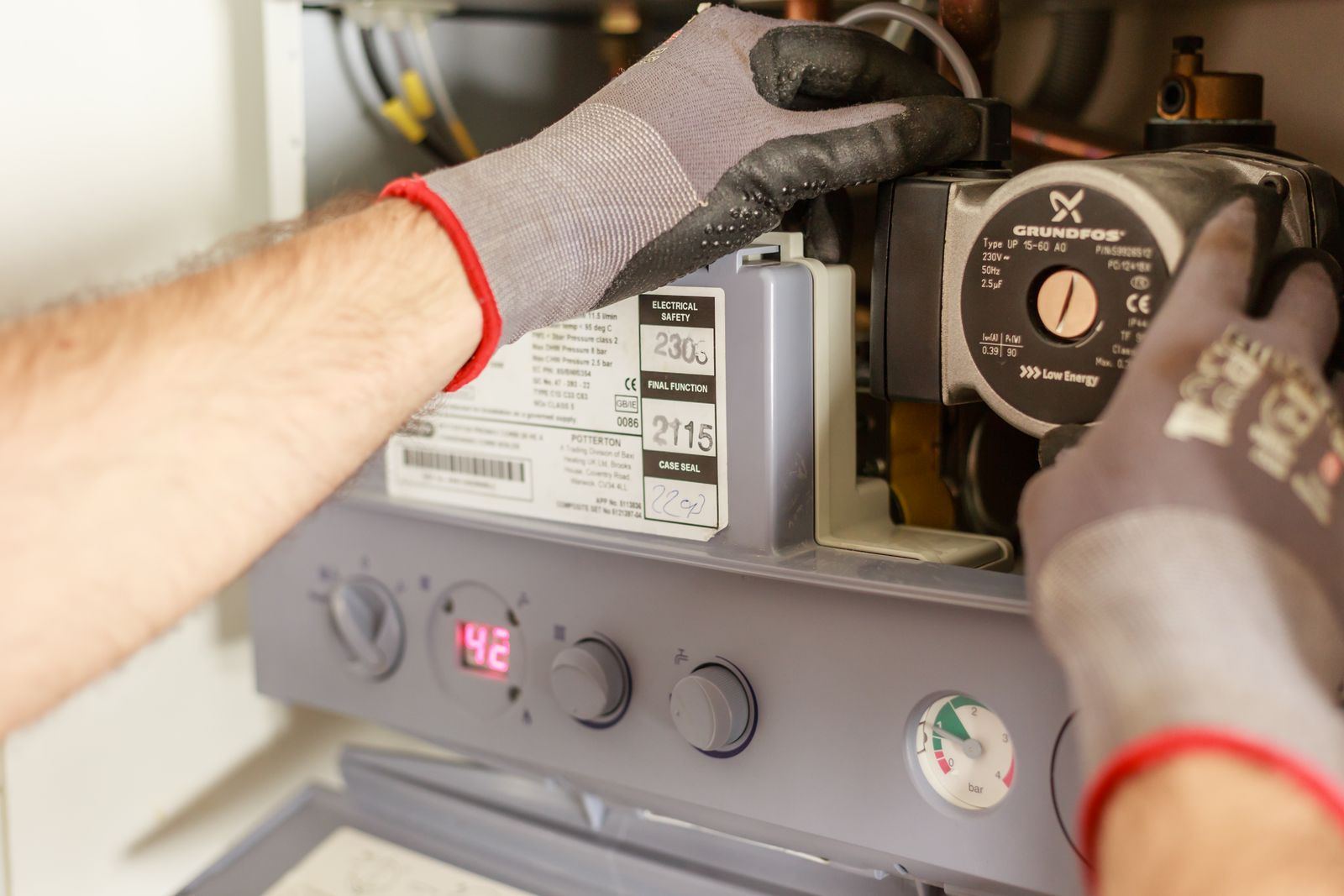
Tankless units are clever machines, and that is both their strength and their weak spot. Instead of keeping forty or fifty gallons hot around the clock, a tankless heater springs into action only when water starts moving: a flow sensor detects demand, the control board fires the burner or elements, and water is heated on its way through the heat exchanger. Every step is watched by a sensor, and if any reading drifts outside its expected range, the board shuts the heater off and displays a code. For Appleton, WI homeowners, that usually traces back to a short list of causes: scale building up inside the heat exchanger, a sticking or dirty flow sensor, an ignition problem at the igniter or flame rod, or a venting or gas supply issue the unit reads as unsafe.
Error codes are a starting point, not a diagnosis, and we treat them that way on every Appleton call. The same ignition failure code can come from a worn igniter, a fouled flame rod, a gas line too small to feed the burner at full fire, or an air intake clogged with lint. That is why Appleton Water Heater tests before replacing anything. Our technicians read the fault history stored in the control board, watch flow sensor output with a faucet open, measure flame signal and igniter resistance, and put a manometer on the gas inlet to see what pressure actually reaches the valve when the burner is running flat out. We also compare inlet and outlet temperatures against the flow rate, which exposes a scaled heat exchanger long before it fails outright.
After the fault is pinned down, most repairs are finished in a single visit. We descale heat exchangers with a pump and descaling solution circulated through the service valves, replace worn flow sensors, igniters, flame rods, thermistors, and combustion fans, clean inlet filter screens, and correct venting problems that trip pressure switches. When the real issue is a gas line sized for the old tank heater, we tell you plainly and quote the correct pipe run, because no amount of part swapping will fix a unit that is starved for fuel. If you are fighting a cold-water sandwich, we explain whether it is normal behavior for your model or a sign of a setting, fixture, or recirculation problem we can correct. Call (920) 200-3343 and we will get your hot water flowing again.
What homeowners call us about most is Water Heater Repair in Appleton. That's the place to start for most homes.
Warning Signs to Watch For
Catching a symptom early is often the difference between a quick part swap and a tank that gives out on the garage floor. Keep an eye out for the following:
- Outlet temperature that surges and sags while water is running
- A heater that only fires when water runs at full blast
- Longer bursts of cold water between hot draws than you used to get
- Leaks under the unit or around its water connections
- The unit clicking or trying to light several times before giving up
- Unusual noises from the cabinet, like a whine, a roar, or a rattle
- A fault code on the front panel and no hot water
- Hot water that cannot keep up with more than one fixture
Small Symptoms, Big Consequences
A little rust-colored water or a relief valve that drips now and then can be the first hint of a tank that is close to the end. Don't wait. Get Appleton Water Heater on the phone at (920) 200-3343 and we'll get a technician scheduled.
Get Tankless Water Heater Repair Handled Today
We'll diagnose the problem and give you a straight answer on the fix.
Call (920) 200-3343 NowCommon Questions We Hear
Why This Job Calls for a Pro
From the outside a tankless heater looks like a plain box; inside, it is a tightly controlled system. A single error code can come from four or five different faults, and the sensors, igniters, and control boards involved are not cheap to buy on a hunch. Gas models add real hazards: the burner can fire at close to 200,000 BTU per hour, the vent carries combustion gases that contain carbon monoxide, and a loose gas connection or a vent joint that separates can put fuel or exhaust into the living space. Electric tankless units carry their own risk, often drawing well over 100 amps across several 240-volt circuits, so a loose lug or undersized wire can overheat quickly.
A trained technician with the right instruments gets to the answer faster. Ours read the fault history, measure flame signal and igniter resistance, test flow sensor output, and check gas pressure under full load with a manometer, which is the only reliable way to catch a gas line that holds pressure at idle but sags when the burner ramps up. Descaling is done with a circulating pump and the proper solution, followed by a thorough rinse. Just as important, you get an honest opinion: if the heat exchanger is damaged on an older unit, you will hear it from us before you spend money on a repair.
How We Handle Tankless Water Heater Repair
We work through a clear, repeatable process so you always know what's happening and what it will cost. Here's a look at each step our team takes:
Read the Unit First
A code points us in a direction, and testing finishes the job. Flow sensor output, flame signal, igniter resistance, inlet gas pressure, and vent condition all get checked before any part comes out of the box.
What We Found & What It Costs
We show you the failed part, explain the cause, and give you a firm price before work begins. If scale has cracked the heat exchanger or the unit is near the end of its life, we say so plainly.
Repair & Descaling
We carry the parts that fail most on tankless units, so flow sensors, igniters, flame rods, and thermistors are usually replaced on the spot, and a descaling flush takes about an hour.
Tested Under Load
A repair is proven, not assumed. We test the unit at low flow and at full demand, confirm a steady outlet temperature, and verify that the code is cleared and does not return.
Questions About Tankless Water Heater Repair?
We give honest advice and upfront pricing on every job, big or small.
Call (920) 200-3343 TodayWater Heater Care Tips From Our Technicians
A little routine care goes a long way toward keeping a water heater running well past its expected lifespan. Here's where to begin:
- Leave the power on in cold weather, since freeze protection only runs when the unit has electricity
- Make sure nothing blocks the exhaust vent or the air intake outside
- Flush scale out of the heat exchanger annually, and sooner in hard water
- Do not keep resetting a recurring code; note it and have it checked
- Have the gas line evaluated whenever you add a range, dryer, or fireplace
- Protect the heat exchanger with a softener or scale inhibitor when your water is hard
- Clean the inlet water filter screen a few times a year so the flow sensor gets full flow
DIY vs. Professional Tankless Water Heater Repair
Online videos may help in a pinch, yet lasting repairs and code-compliant installs depend on correct venting, proper relief valve discharge piping, and a trained technician. Here's a comparison:
| Factor | Doing It Yourself | Professional Service |
|---|---|---|
| Diagnosis | Look up the code and replace a guess | Code confirmed by component testing |
| Scale Removal | No pump or isolation valves | Proper solution, pump, and flush time |
| Combustion Safety | Gas pressure and vent joints unchecked | Gas pressure and vent run verified |
| Electrical Work | Live wiring inside the cabinet | Circuits and board checked with proper tools |
| Replacement Parts | Generic parts that may not fit the model | Model-matched parts, often on the truck |
| Outcome | Temporary fix at best | Lasting repair, confirmed by testing |
Talk to Our Tankless Water Heater Repair Team
Every day a leak or a failing part goes unchecked puts more stress on the tank. Get Appleton Water Heater on the job today.
Call (920) 200-3343 TodayCommunities We Cover
We serve Appleton and its neighboring towns for tankless water heater repair, from quick same-day repairs to planned installs.